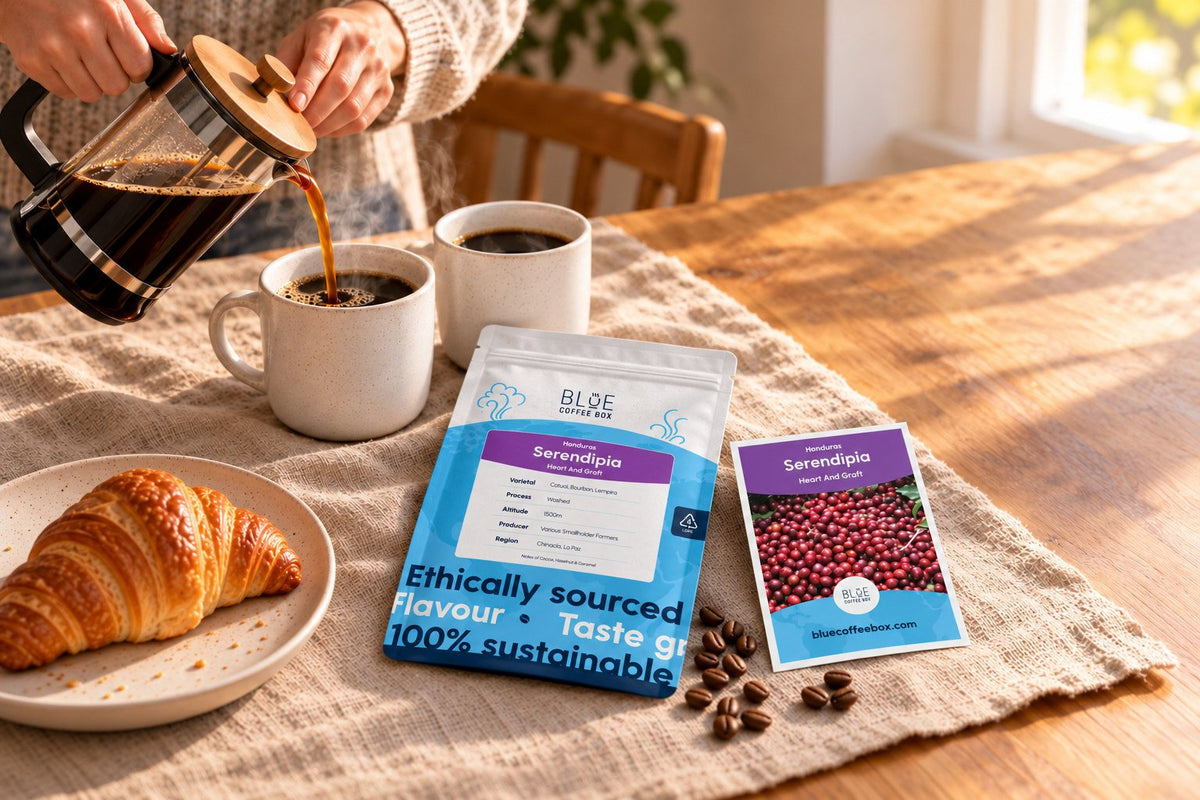
The French press, or cafetière, is one of the easiest ways to make great coffee at home. You don't need a barista's skills or expensive kit, and it's easy to adjust to your taste. Here's our step-by-step method, plus a few tips that make a big difference.

What you need
- A French press (cafetière)
- Freshly roasted coffee, whole beans or ground for a cafetière
- A grinder, if you're using beans
- A kettle
- Scales
- A timer
- A spoon
The ratio
A good starting point is 30g of coffee to 500ml of water, which is roughly 1:16. For a stronger cup use a little more coffee, and for a lighter one use a little less. Here's more on how much ground coffee to use.
How to use a French press
- Boil the kettle with fresh, filtered water, then leave it for about a minute. Just off the boil, around 93 to 96°C, is ideal.
- Warm the press. Swirl a little hot water around the jug, then pour it away.
- Grind the coffee medium-coarse, a bit like sea salt. Too fine and the coffee will taste bitter and be hard to plunge; too coarse and it will taste weak.
- Add the coffee and water. Put the press on your scales, add the coffee, then pour in the water.
- Stir and wait. Give it a gentle stir, put the lid on with the plunger up, and brew for 4 minutes.
- Plunge slowly and steadily all the way down.
- Pour it all out. Serve straight away, or decant into a jug, so the coffee doesn't keep brewing on the grounds and turn bitter.

Tips for better French press coffee
Use fresh coffee
This makes the biggest difference of all. Look for a roast date on the bag and use the coffee within a few weeks of roasting. Here's how long coffee stays fresh.
Choose good coffee
Speciality single-origin coffees are grown and roasted to bring out their own flavours, and a French press is a great way to taste them, because the mesh filter lets through the coffee's natural oils for a rich, full body. Read more about the main types of coffee beans.
Get the grind right
If you grind at home, a burr grinder gives a much more even grind than a blade grinder. Avoid these common grinding mistakes.
Use good water
Coffee is mostly water, so if your tap water tastes of chlorine, your coffee will too. A filter jug helps. Avoid distilled water, because the minerals in water help bring out the coffee's flavour. More on the best water for coffee.
Keep it clean
Coffee oils build up on the mesh and glass and can make your coffee taste stale. After each use, scoop out the grounds (they're great on the compost heap, but don't tip them down the sink), then take the plunger apart and wash it. Every so often, soak the parts in warm water with a little white vinegar or a coffee equipment cleaner.

Choosing a French press
They come in glass, stainless steel and ceramic. Glass lets you watch the coffee brew, while steel keeps it hot for longer and won't break. Pick a size that suits how much coffee you drink, as it's best to make just what you need.
Once you've got the basics, experiment. Try a slightly longer brew or a different ratio until it tastes just right to you.
New to brewing? See all our brewing guides, with the grind, ratio and brew time for every method.
Discover a new coffee every delivery
Get a different single-origin speciality coffee from the UK's top independent roasters, freshly roasted and 100% arabica. Choose whole beans or a grind for your brewer, including decaf. Free UK delivery, and you can skip a delivery, change your date or cancel anytime.